


 56 / 116

56
/
Flight Time
/
NOVEMBER 2018
Wanderlust
F L I G H T D E TA I L S
Flybe has flights to Paris CDG from
Aberdeen, Birmingham, Cardiff,
Doncaster Sheffield, Edinburgh,
Exeter, Manchester, Newcastle and
Southampton. Some of these flights
may be operated by Air France. Flybe’s
franchise partner Eastern Airways has
flights to Paris Orly Ouest from Rodez.
The Caveau and the whole Parisian jazz
scene shows that the music that most evokes
Paris does not always originate here. The
city has always been a magnet for outsiders.
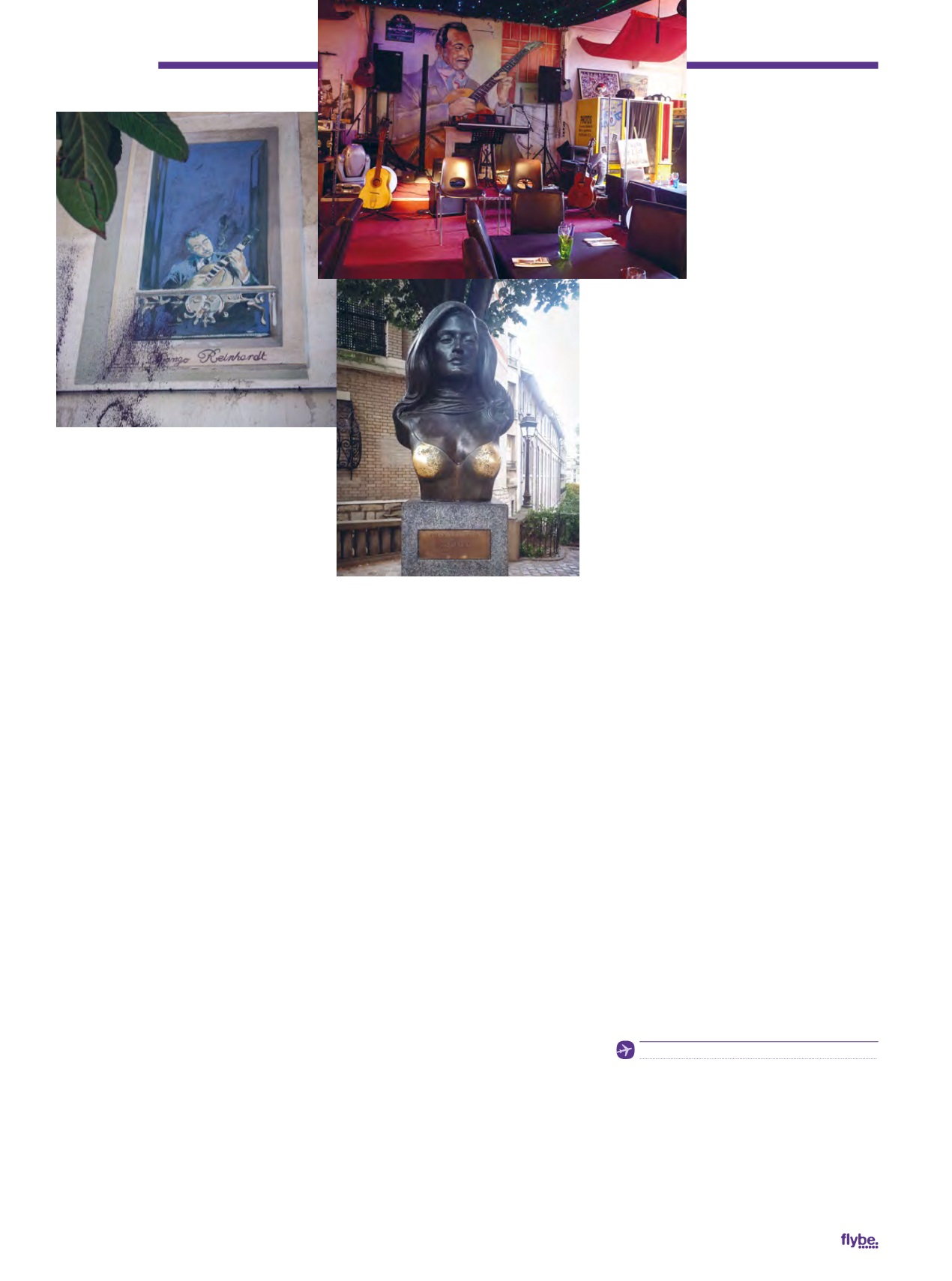
In the 1920s, Django Reinhardt’s gypsy
family came from Belgium and parked their
caravans outside the old city gate at Porte
de Clignancourt. Reinhardt was inspired
by the black American musicians he heard
in the city to introduce jazz rhythms to his
guitar-playing, with amazing results.
By the Second World War, Django, with
his quintette, the Hot Club de France, was
France’s biggest musical star and a hot ticket
everywhere from the Carnegie Hall to the
Glasgow Empire.
Near Porte de Clignanourt, there is
a café, La Chope des Puces (
122, rue des
Rosiers
), filled with Django memorabilia that
keeps the flame alive with gypsy jazz shows
every weekend.
Even leaving aside Django and the
American jazzers, I have learned that
the French chanson is a broad church.
Sometimes, it is heart-wrenchingly
emotional; sometimes a music-hall
singalong. Charles Trenet, maybe the
greatest chansonnier of all, sounds like Noël
Coward discovering a cocktail jazz band in
his summer house. Jaunty.
One man keeping the flame burning
is Jacques Pessis, who has written over 30
books on traditional French chansons and
chansonniers (see box on previous page).
Jacques has also written celebratory stage
plays about some of the greats, aimed at
spreading the word to new audiences.
I see his
I Love Piaf
, an upbeat
entertainment, dwelling more on Piaf’s
triumphs than her traumas, with big-voiced
pop singer Mtatiana winningly belting
out the Little Sparrow’s songs. Jacques’
show about Georges Brassens is playing
at Montmartre’s Théâtre Trévise (
www.
theatre-trevise.com )from 14th November
to 12th December, while
I Love Piaf
’s next
Parisian outing is on 26th December, also at
the Trévise.
The spirit of old France is also kept
alive by people like Stephane Aubry of the
Chansons Association. Where better to
meet him than in the beautiful belle epoque
Bonne Franquette bar in Montmartre,
once frequented by Monet, Van Gogh and
Cézanne? Stephane takes me on a walking
tour that helps me see beyond the milling
tourists of 2018 to the old hilltop bohemian
quarter of days gone by.
Down a cobbled street past the
Montmartre museum, Stephane takes me
to the empty Place Dalida. Untroubled
by tourists, it sums up how little of the
rich history of French song has travelled.
The square has a larger-than-life statue
of Dalida, a former Miss Egypt whose
impassioned balladry made her a huge star
in 1960s France, right up until her death in
1987, without ever troubling the English-
speaking world.
Then again, here is the Chez
Eugène creperie, mentioned by a more
internationally-known local resident,
Jacques Brel, in his song
Madeleine
(the chips
are so good that it is worth taking a bus
to the place, apparently); here, on random
days in the square behind the Sacré-Coeur,
you might still see veteran, eccentric
chansonnier Arlette Denis busking, having
pulled her barrel organ to the top of the
hill on a little trolley behind her bike. A bit
further on, a little old house called Au Lapin
Agile, former haunt of Picasso and Toulouse
Lautrec, has a traditional cabaret every
night except Mondays. (Like some kind of
old music hall joke, it really is free to get in
and €28 – with a drink – to get out).
In the end, the old French magic was
dealt a fatal blow by rock’n’roll. Piaf died at
47 in 1963. Three months later, The Beatles
began an 18-day run at the Olympia in Paris.
English-language pop took over. Johnny
Hallyday taught France to rock’n’roll and the
old music was kicked into the long grass.
There may have been a time when
France’s attempts to shadow British and
American rock’n’roll were met with
amusement at best in the English-speaking
world. Hallyday’s international reputation
as the French Elvis was always a case of
damning him with faint praise. But no-one
mocks French pop now.
No country produces cooler artists than
Christine and the Queens or Daft Punk.
But the old Paris magic is still out there
too, if you know where to look.
Thanks to Guillaume Le Roux of levraiparis.
com, who leads tours showing visitors an
insider’s view of Paris.
Far left: a trompe l’oeuil of
celebrated guitarist Django
Reinhardt
Left: The interior of La Chope
des Puces, the Django
Reinhardt bar; the Dalida
statue in Place Dalida