


 54 / 116

54
/
Flight Time
/
NOVEMBER 2018
Wanderlust
Previous spread: the
legendary Edith Piaf
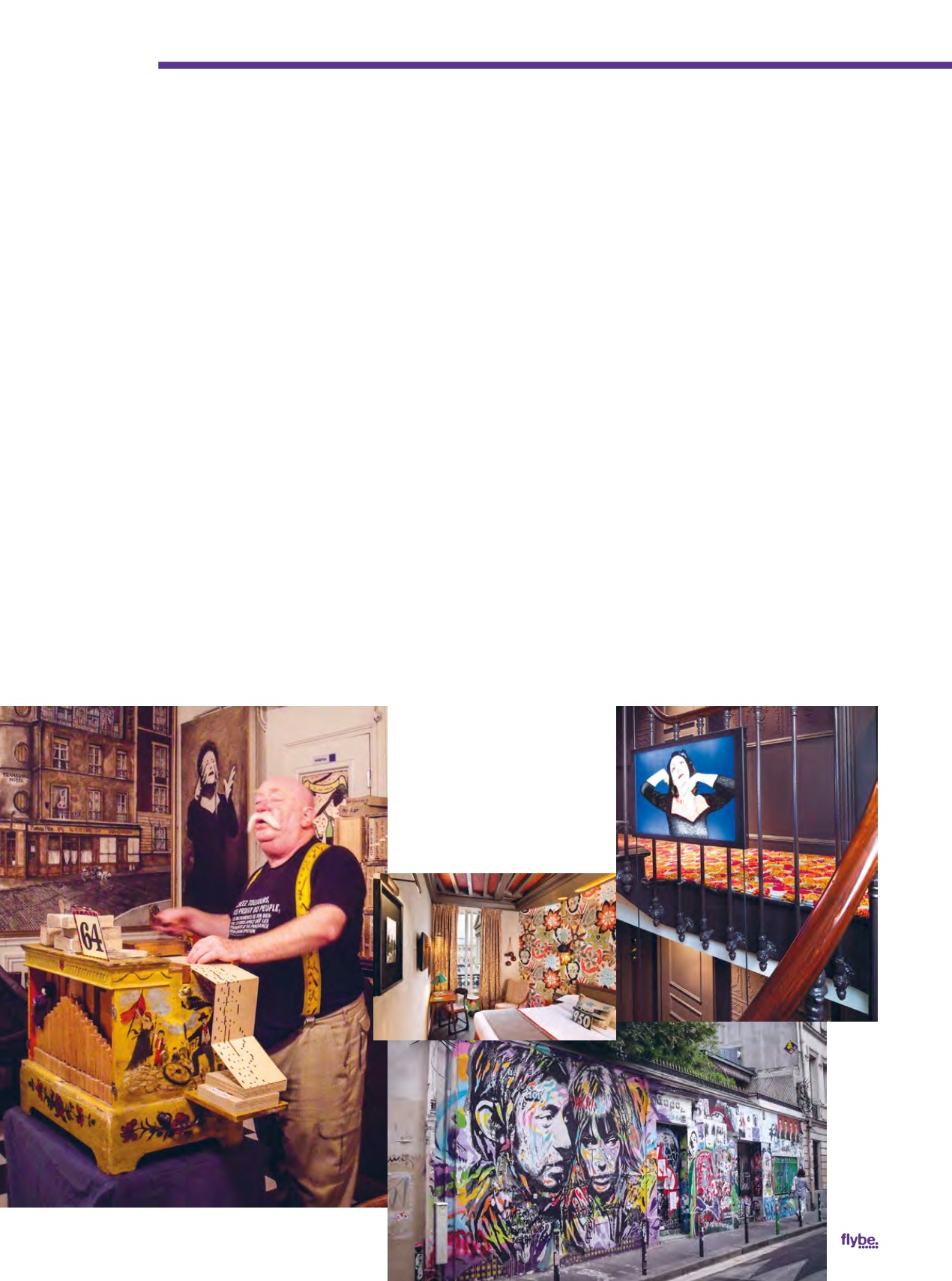
Clockwise from left: Riton
la Manivelle at Le Vieux
Belleville; retro guest room
in Les Dames du Panthéon
hotel; the Piaf portrait in the
hotel; graffiti on the wall
outside Serge Gainsbourg’s
flat in St Germain
moustache arrives, bringing a trolley full
of carefully-labelled cardboard boxes. He
has the look of Obelisk, Asterix’s sidekick.
His name is Riton la Manivelle and he is
tonight’s entertainment. In the boxes are the
music rolls for his barrel organ, classic songs
by Piaf, Charles Trenet, Georges Brassens
and more.
At 9pm, with dusk settling over the city
below, we go inside and Riton turns the
handle on the first number. He sings along,
lustily and with plenty of drama and stage-
whispered asides.
There are specially-printed songbooks
on the tables. Before each song, Riton puts
up a little sign with its number on and
soon everyone is singing, even those whose
French is rusty or non-existent.
However sad a chanson’s story may be,
it’s a fair bet that it will have a rousing
singalong chorus.
Hymne à L’Amour
is
about Piaf’s doomed affair with boxing
champion Marcel Cerdan, killed in a plane
crash on his way to see her: Riton sings it
a capella and it feels oddly life-affirming
and unbearably poignant all at the same
time. He is here every Thursday. On Fridays
and Saturdays, there’s a singalong with an
Just across the square is the spot where,
in Woody Allen’s
Midnight in Paris
, Owen
Wilson waits each night to begin his time-
travel adventure back to the 1920s.
I have to piece my own trip to the
past together myself, though. There’s no
official museum for any of this old French
soundtrack. There is, however, a private
museum to Piaf (
5, rue Crespin du Gast
), run
by a fan who met her as a teenager, but visits
are by appointment only and availability
is unpredictable. Likewise, it’s left to fans
to commemorate Serge Gainsbourg, by
graffiti-ing the walls outside his old flat in
St Germain, where he lived from 1969 to his
death in 1991 (
5
,
rue de Verneuil
). Walking
back to the Metro, I stop at La Louisiane
(
60, rue de Seine
), the unpretentious hotel
where visiting American greats like Billie
Holiday, Charlie Parker and Miles Davis
used to stay in the 1950s, a scene celebrated
in the classic jazz film,
Round Midnight
.
That 1940s and 1950s scene saw a new
wave of American jazz and swing in Paris,
as black musicians rushed to a country that
treated them not as second-class citizens but
as legendary artists.
The old clubs where war-weary Parisians
accordionist; every Tuesday there’s a Piaf
evening.
Next morning, I wake up with Piaf on
my mind. It’s hard to avoid. I am staying
on the Edith Piaf floor of Les Dames du
Panthéon, a chic new boutique hotel in the
5th arrondisement (
19, Place du Panthéon
).
The hotel overlooks the Panthéon, a huge
secular memorial to the greats of French
history, and celebrates the women who are
missing from it. There are also floors for
writers George Sand and Marguerite Duras
and chanteuse Juliette Gréco. My room’s
decor is ’50s retro; the lobby has a Piaf
songbook opened to
Hymne à L’Amour
, and a
giant, alarmingly-dramatic portrait of Piaf
hangs in the stairwell.
“Before each song,
Riton puts up a little
sign with its number
on and soon everyone
is singing along, even
those whose French is
rusty or non-existent”