


 55 / 116

NOVEMBER 2018
/
Flight Time
/
55
Wanderlust
immersed themselves in liberating sounds
from the New World are mostly long gone,
but there are well-recommended, new
venues. The Jazz Cafe in Montparnasse (
13,
rue du Commandant René Mouchotte
), has free
entry and a dinner menu (though you are
free to sit nursing a cocktail); in the north-
east, La Gare (
1, avenue Corentin Cariou
) is
one of a roster of new, independent venues
in old railway stations: it is also free to see
an international programme of artists in a
terrific, out-of-the-way setting.
But tonight, I am headed to one of the
last surviving haunts of the 1940s.
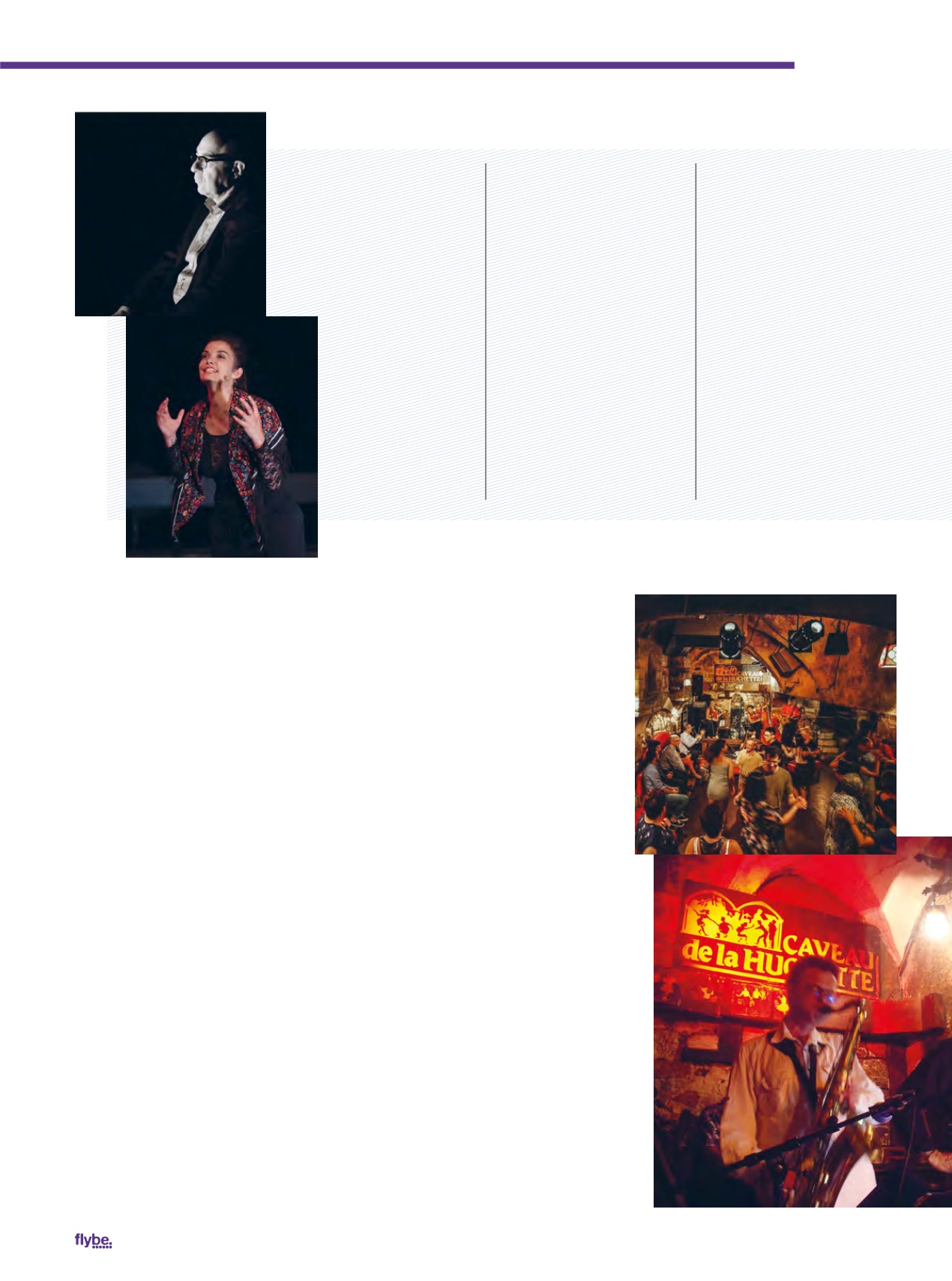
It is past 11.30pmwhen I come to Le
Caveau de la Huchette, the cellar jazz club that
has been open since 1946 (
5, rue de la Huchette
).
It is legendary enough to have featured in a
dream sequence in last year’s Oscar-winning
hymn to song and dance,
La La Land
.
The Caveau is right in tourist central,
two minutes from Notre-Dame. As I make
my way down the spiral, stone staircase from
the ground-level bar into the cellar, a musty
wave of heat rises to greet me. (What was it
like down here when smoking was virtually
compulsory?) The venue is small and packed.
There’s maybe 50 people, watching and
dancing to A Swinging Affair, a French
quartet led by two saxophones. The crowd is
a rare mix of young Americans, Japanese and
Koreans, alongside older French music fans
dressed in full ’40s kit.
Is it touristy? Well, it’s hard to imagine
the emotional edge of Paris’ post-war years,
when bebop and peace were new, and hip
Parisians wanted to shake off the past by
embracing the most modern and exotic
music they could find.
But you can’t doubt that, here in 2018,
this band and this crowd love this music.
In the breaks, young strangers from across
the world chat each other up, as they take
a breather in the upstairs bar or out on the
cobbled street.
There’s no doubting the band’s
credentials, either. Patrice Galas, the piano
player, has been a sidesman for many big
names since the early ’70s. In a break, he
tells me the band are playing three hours’
music tonight. Patrice says that as recently
as the 1990s there were 130 jazz clubs in the
city. Now it is down to single figures.
Did rock’n’roll kill chansons?
It changed everything. We
went from the 1950s which had
been very poetic, straight into
rock’n’roll. Apart from Piaf,
Aznavour, Brel and Trenet,
everyone else disappeared.
French songs just became
copies of English or American
songs. No-one thought
rock’n’roll would last. They all
thought Johnny Hallyday would
be a passing fad.
The important thing is that
young French people can
appreciate those old songs and
see how different they were to
what comes out of France now.
They are tired of all the marketing.
They want to be touched by
great melodies and lyrics.
Paris. It went both ways: from the
1930s, French singers, especially
Charles Trenet, began to be very
influenced by American jazz.
The big old French stars –
Maurice Chevalier, Piaf, Trenet
– were all properly-big stars in
America.
Did Piaf fit into a tradition of
French song or did she break
the mould?
Piaf is a whole new category.
She had a completely unique
voice, she sang with all her heart,
always full of emotion. She was
the first singer who was able to
touch people with songs that
came from the street, gritty
songs that showed the truth of
everyday life.
Jacques Pessis, who wrote the
I Love Piaf
stage show shares his
thoughts on Piaf, French chanson
and its demise
What defines French chansons?
Charles Aznavour said to me
once that the idea of ‘chansons
Françaises’ as separate to
American or British
popular songs is wrong.
The whole style of a
classic Broadway or
West End show comes
from France in the first
place.
The Ziegfeld Follies
was the first revue on
Broadway, in 1907, and it
was completely inspired
by the Folies Bergères in
“Le Caveau is
legendary enough to
have featured in last
year’s Oscar-winning
hymn to song and
dance,
La La Land
”
Top: Jacques Pessis who wrote the stage show
I Love Piaf
, and its star, Mtatiana
Right: Le Caveau de la Huchette in action