

 39 / 116

SEPTEMBER 2018
/
Flight Time
/
39
Real Life
that it would be maybe four years
before my son could even consider
training for an artificial limb
controlled with electrical signals
generated by muscles,” said Ben.
“There’s a critical window between
the ages of two and three when a
ruthless brain pruning takes place,”
says Ben. “I wanted to do as much
as I could to promote the use and
strengthening of the pathways before
this happens, not just to control
the arm, but the perceptual nerve
pathways as well.”
During infancy, the brain
experiences a rapid period of growth
which plays a vital role in learning,
memory formation, and adaptation
early in life. Between the ages of two
and three, the number of synapses
(brain structures that allows the
neurons to transmit an electrical or
chemical signal to another neuron)
hits a peak level. But then shortly
after, the brain starts to remove
synapses that it no longer needs.
Ben began experimenting by
taping an ‘arm’ of rolled-up foam to
Sol’s elbow to see what would happen.
Almost immediately, Sol began
playing, using the foam “arm” for the
first time. That was enough for Ben. It
became his mission to create a better
prosthetic arm for his son, and for
other children in the same situation.
Using pipe and plumbing fittings,
he came up with a design that would
operate a hand using tiny movements
of the elbow. He then took it to the
newly-opened innovation laboratory
at Bangor University and asked them
for help. They were only too happy
to put their new equipment to good
use and, using state-of-the-art 3D
printing technology, turned Ben’s DIY
effort into a workable solution.
Ben set up a new company,
Ambionics, to develop his arm and
concentrate full-time on prosthetics.
He has since won the backing of some
big companies, including Santander
and Microsoft.
SUPPORT I NG
AMB ION I CS
Ben has garnered praise
from a number of sources.
“Ben has gone from having
essentially no background in product
design to becoming an expert in
designing and manufacturing digital
prosthetics. His passion for innovation,
willingness to challenge convention
and humble attitude make him
a perfect example of a start-up
founder that will change the lives of
many people all over the world.”
Simon Leigh, Associate Professor,
Warwick University School of
Engineering
“The prosthetic hand produced
by Ambionics has amazing clinical
value which we believe will
provide an unparalleled
opportunity to learn just how
prostheses can be integrated
during infancy and childhood.”
Dr Kia Nazarpour, Intelligent Sensing
Laboratory, School of Engineering,
Newcastle University
“Ambionics is a representation of
many things to me. Not only is Ben
pulling himself up by the bootstraps
to help his son, he’s demonstrably
proven that the prosthetics world
is ready for a paradigm shift,
particularly when it comes to
how we think about prosthetics
for children. What really excites
me about this is how Ben is able
to work in a true, pure digital
method, allowing him to connect
with parents and clients from all
over the world.”
Paul Sohi, Product Designer, Autodesk
“The proposition and creative
genius of Ambionics in using 3D
printing and new materials to
the benefit of prosthetics has the
potential to revolutionise the lives
of thousands of children (and
adults) in the UK alone. I believe
this product is a true game-
changer that creates a significant
step change in the field of
prosthetics.”
Dr Louise Jones, 3D printing/Additive
manufacturing lead, Knowledge
Transfer Network
At first the project was funded by
family and friends, but Ben is now
campaigning to raise at least £150,000
to satisfy medical authorities his arm
prosthetics are safe to use, finalise
patents, and to develop the design. If
he can raise more, he wants to fund
medical research trials to back up his
own theories on how young children
learn to use artificial limbs.
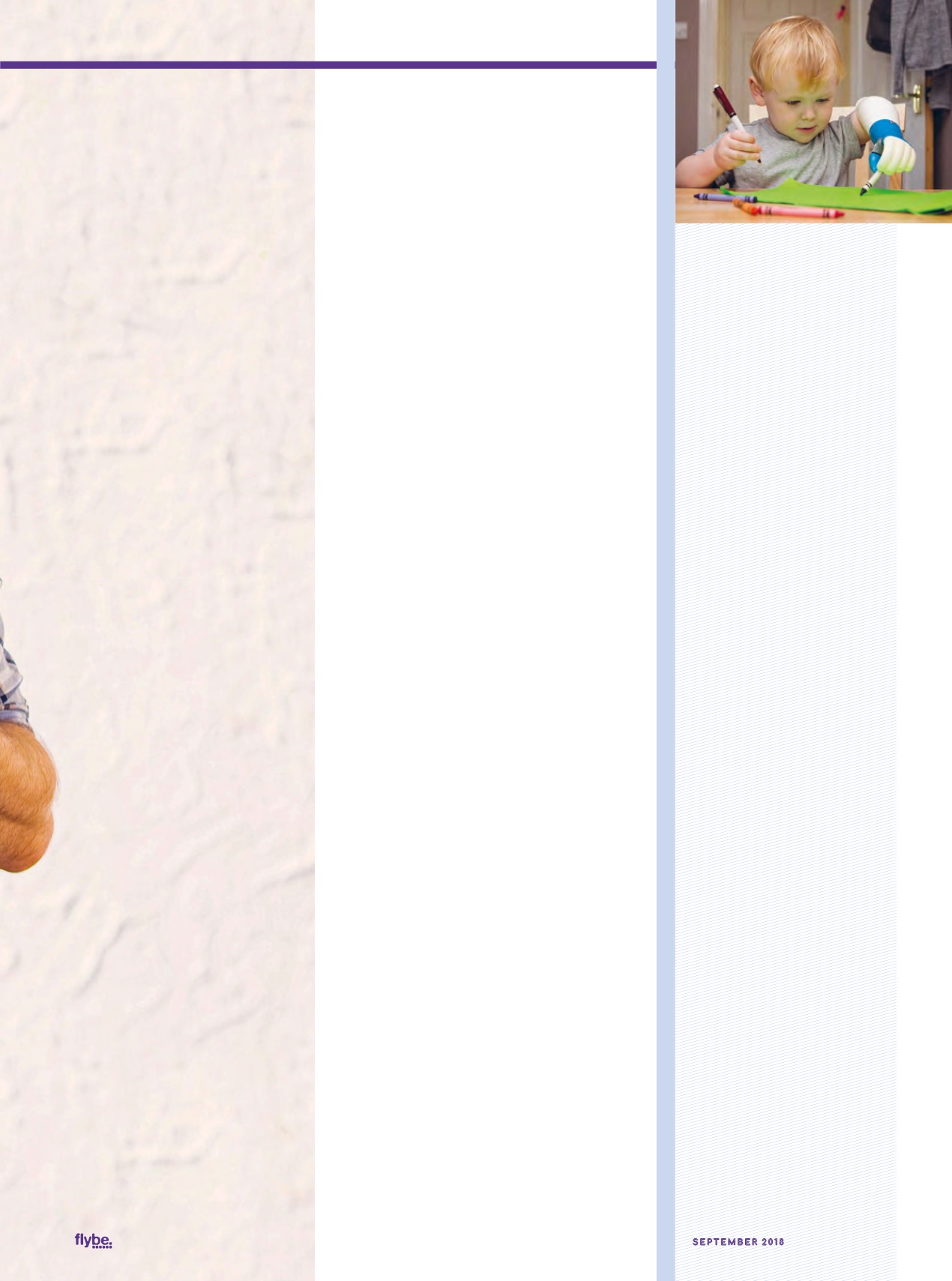
Today, Sol has a new prototype of
an arm and hand that can grip, with
a moveable thumb. The idea is that
it can be used to train children under
three years of age so that they can
accept more complex prosthetics later
on, and avoid becoming one of the 70
per cent of children who reject them.
Because he’s worn the arm every day,
Sol is one of the few amputees that
doesn’t have any muscle atrophy on
his affected side. What’s more, the
arm can be built and printed in just
days, compared to the three months
it takes to build a fibreglass prosthetic
arm through the NHS.
Meanwhile Sol – the Ambionic
Boy as his dad calls him – can do 90
per cent of the things that children
with two hands can do.
“I just want to help him adjust to
those 10 per cent of tasks he is going
to find difficult,” said Ben.
“The point I will relax is when I see
him reach for something and be able
to pick something up just naturally.
That’s when I’ll know that I’ve done a
good job.”
If you would like to support Ben’s
work, visit
www.ambionics.co.uk“The point I will relax
is when I see him reach
for something and be
able to pick something
up just naturally. That’s
when I’ll know that I’ve
done a good job”