

 34 / 116

34
/
Flight Time
/
SEPTEMBER 2018
Interview
better than the finished drawings, and I
should put my pencil down earlier! I did so
and the rest, as they say, is history!”
He may be a creative at heart, but Blake
also has a practical and intellectual side, and
rather than follow the route of impoverished
artist, upon receiving his postgraduate
teaching diploma from the University of
London he began teaching at the Lycée
Français de Londres (a French primary
and secondary school funded entirely by
the French government) in Kensington.
This inclination toward the Gallic appears
to be inherent, for Blake’s parents lived in
France before he was born, and French food,
language, music and art were woven into his
home life.
The admiration turned out to be entirely
mutual, with Blake enjoying a certain level of
celebrity across the Channel. And when the
famed publishing house Éditions Gallimard
bought the French publishing rights for
Dahl and Blake’s picture book
The Enormous
Crocodile
, it marked the beginning of a long
and illustrious union between publisher and
illustrator which has allowed all of Blake’s
UK books to be made available in France,
along with some written exclusively for
the French market, including
Promenade au
Pays de la Poésie Française
(which roughly
translates to ‘walk in the country of French
poetry)’, an anthology of French poetry
aimed at the youth market.
Although spending a huge amount of time
submerged in rural French culture, Blake
insists he approaches every project with
the same mindset, a trait the French appear
to appreciate. “I would say that I am more
influenced by the landscape than the culture,
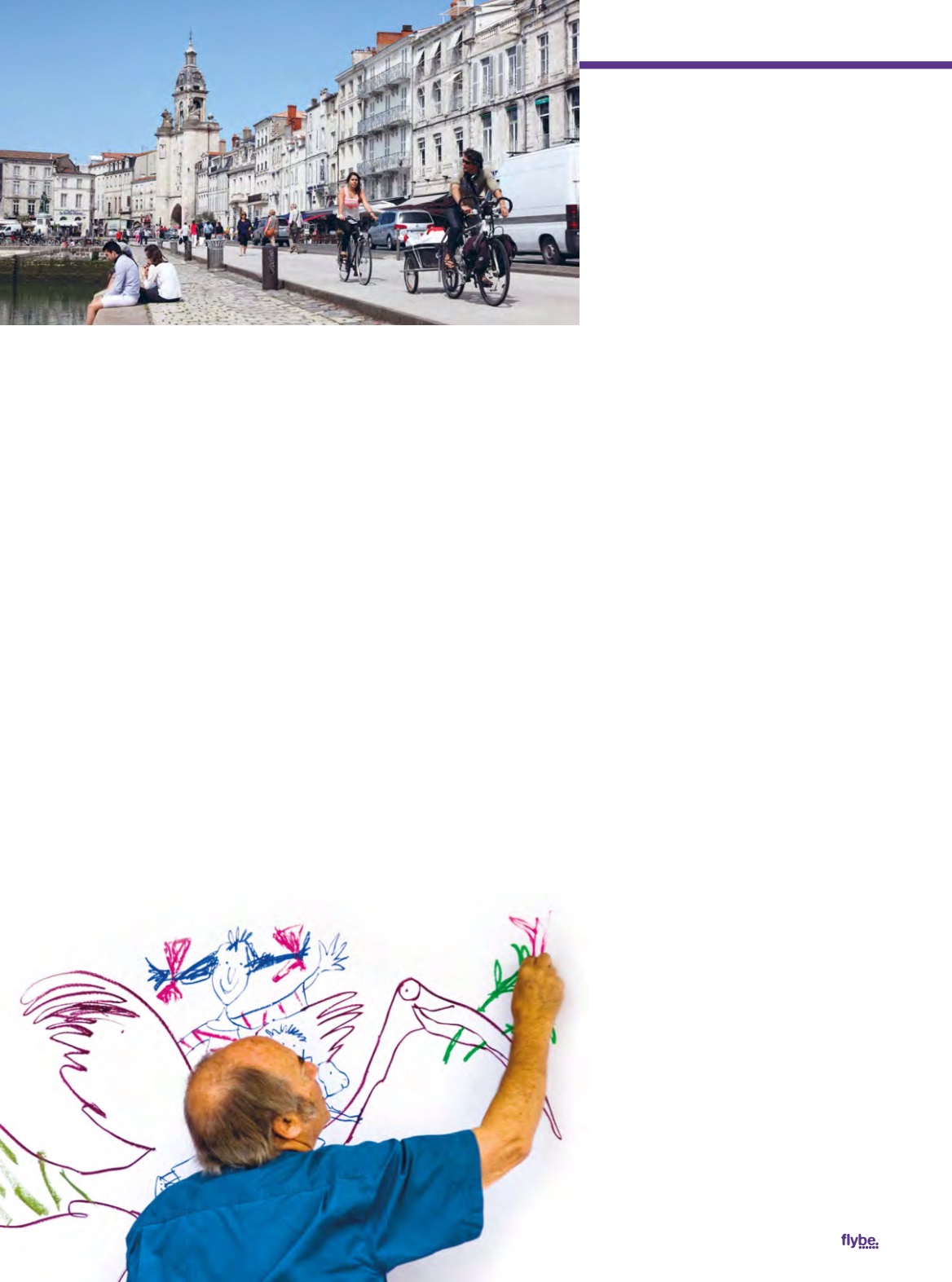
and the landscape of La Rochelle and of
France is utterly unique. The French always
tell me that British humour is completely
unique; well, I tell them their countryside is,
so it’s a fair exchange!” he laughs.
“What I love about this region, too, is
the fact almost every decent-sized town has
a book fair. As a result, I’ve been to so many
areas and been very much embraced by the
people, and that’s wonderful because you’re
taking part; you don’t feel like a stranger,
which can sometimes happen when abroad.
“I don’t think that would ever happen in
this region of France, though – the people
are so warm, and they make coming back a
pleasure. And I could never be bored here
– all the charming cafés and restaurants
you would expect, incredible architecture,
charming boats and the most immaculate air
to breathe in. It has everything.”
For someone so influenced by France,
Blake remains quintessentially British,
and within that retains a certain joy and
impishness of youth, his mischievous eyes
appearing almost a living apparition of one
of his beloved creations. For it is that same
creative vigour, with minimal pen strokes,
that makes his iconic characters jump up
and run off the page. Indeed, although best
known for the stories he created with Roald
Dahl, Blake has in fact illustrated over 300
children’s books, including those written
by Joan Aiken, David Walliams, Elizabeth
Bowen, Sylvia Plath, Nils-Olof Franzén,
William Steig and Dr Seuss.
With such a vast catalogue of weird and
wonderful characters, you wonder how the
eclectic artist doesn’t find himself fatigued by
the process, or at least prone to repetition.
But when Blake talks of his work, you are
reminded of that almost magical quality
many creatives possess as they sculpt, tease
and tempt their figures from some powerful
parallel universe which is quite invisible to
the rest of us.
Explains Blake: “When working with
someone else’s text, I start off with a lot of
reading and only a little drawing. Eventually
the person in the situation you invented
takes on that character, so you sort of meet
them by drawing them.
“I’ve noticed if I look back, by the time
the character has got into the book, he or
she bears no resemblance to the first person
I drew, or the personality feels completely
different. In essence, I learn to know them by
drawing them. It’s a wonderful process.”
There is naturally a great deal of pressure
“What I love about this region, too, is the fact almost
every decent-sized town has a book fair. As a result,
I’ve been to so many areas and been very much
embraced by the people, and that’s wonderful because
you’re taking part; you don’t feel like a stranger”