


 43 / 116

SEPTEMBER 2018
/
Flight Time
/
43
Inspiration
are thin on the ground in Docklands, but
building sites? Well. Part of the strange
experience that is Docklands is the sheer
quantity of building sites. Unfinished, not
fully formed, fenced in behind hoardings,
they make you a little anxious. What will
they become? What will they offer?
So it’s nice to hit Trinity Buoy Wharf
next, a patch of Docklands that has human
imprints all over it. For nearly the entire
19th and 20th centuries, the wharf – tucked
into the fold where the River Lea meets the
Thames – operated as the workshop for the
Corporation of Trinity House, who were
responsible for pushing forward the use
and design of buoys, lightships
and lighthouses – London’s last
lighthouse stands on the site.
The most famous creative
mind to work here was Michael
Faraday, inventor of the electric
motor. A spirit of innovation
lives on at the wharf in a range
of artistic works – the most
striking of which is Longplayer,
a musical composition designed
to play without repetition for
1,000 years. Whether or not
you’re in the mood for creativity,
the site is fun to wander around,
with its colourful shipping
containers, street art and other
maritime-influenced installations
– and sense of isolation. It’s
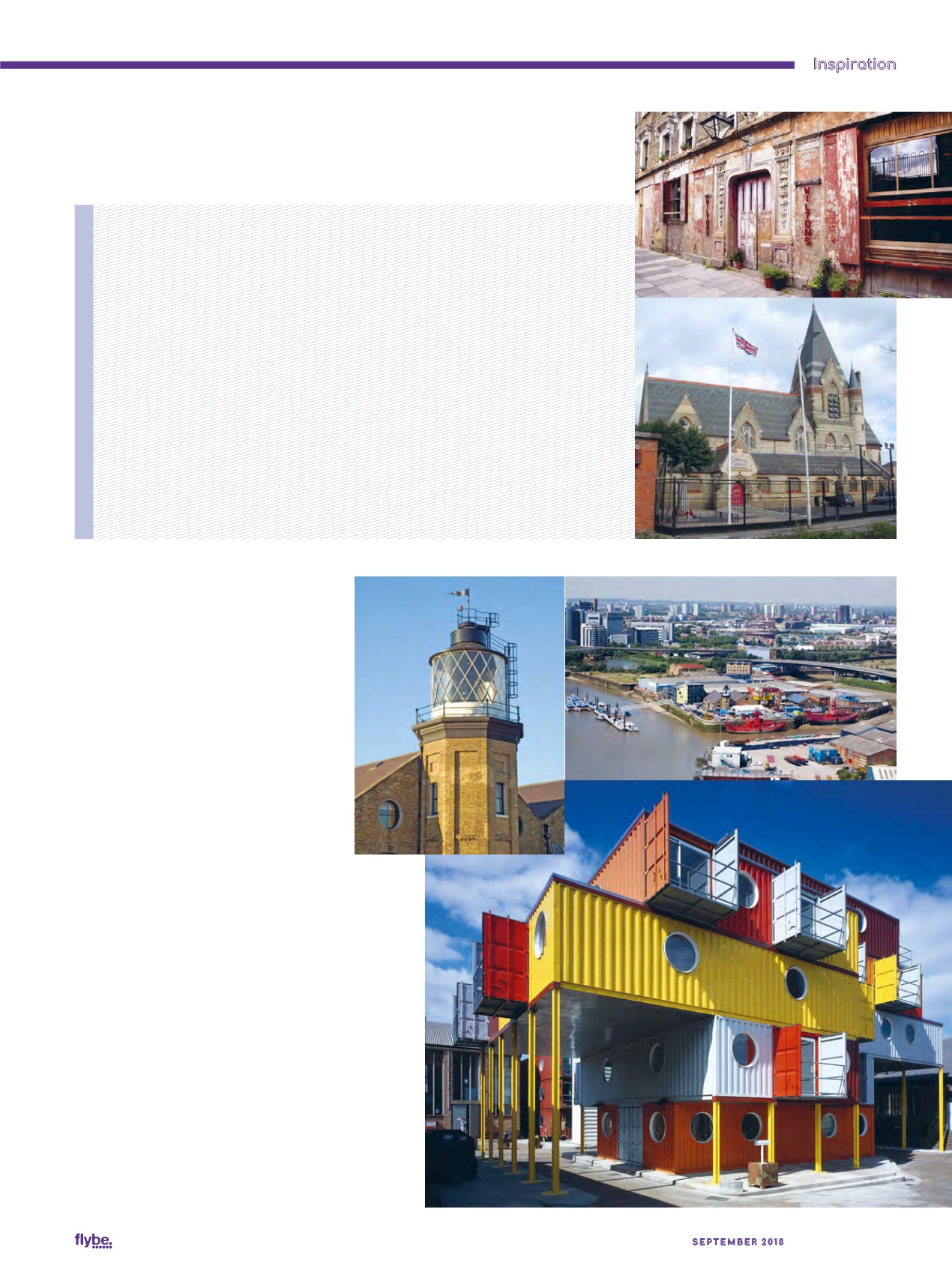
Clockwise from
above: London’s
only lighthouse, by
the confluence of
the Thames and Bow
Creek; Trinity Buoy
Wharf is becoming
Docklands’ most
exciting arts quarter;
colourful shipping
containers at Trinity
Buoy Wharf
TRAD I T IONAL
MUS I C HALLS
OF DOCKLANDS
Docklands boasts London’s
two most important sites
for anyone remotely
interested in traditional
Cockney music hall, a form
of wink-wink-nudge-nudge
musical entertainment
that was popular from
Victorian times right up
until the 1960s. Convoluted
song titles such as
It’s A Bit
Of A Ruin That Cromwell
Knocked About A Bit
(memorably performed
by Marie Lloyd) give
an idea of its cheeky
approach. The oldest
surviving purpose-built
music hall, Wilton’s (right,
top;
www.wiltons.org.uk ),
lies just north of Wapping,
at 1 Graces Alley. To
evoke a sense of fading
heritage, the décor is kept
atmospherically shabby
chic. Note that the Wilton’s
programme includes lots of
regular theatre as well as
the occasional traditional
music-hall event, and the
on-site bar is great even
if you’re not catching a
performance. Brick Lane
Music Hall (right, belo
w;
ww.bricklanemusichall.
co.uk )is a different kettle of
fish. Located in the far east
of Docklands, just south of
City Airport, this one is an
honest-to-goodness, 100
per cent music-hall venue
– located in a former
church that used to serve
the workers of Silvertown.
Note that it’s nowhere near
Brick Lane! The owner’s
original music hall was on
that famous East End street
and he named this venue
in its honour.