

 71 / 116

JULY 2018
/
Flight Time
/
71
att Williams is on a
mission to make Britain’s
barbecues better: not
just their flavour, but
their impact on the
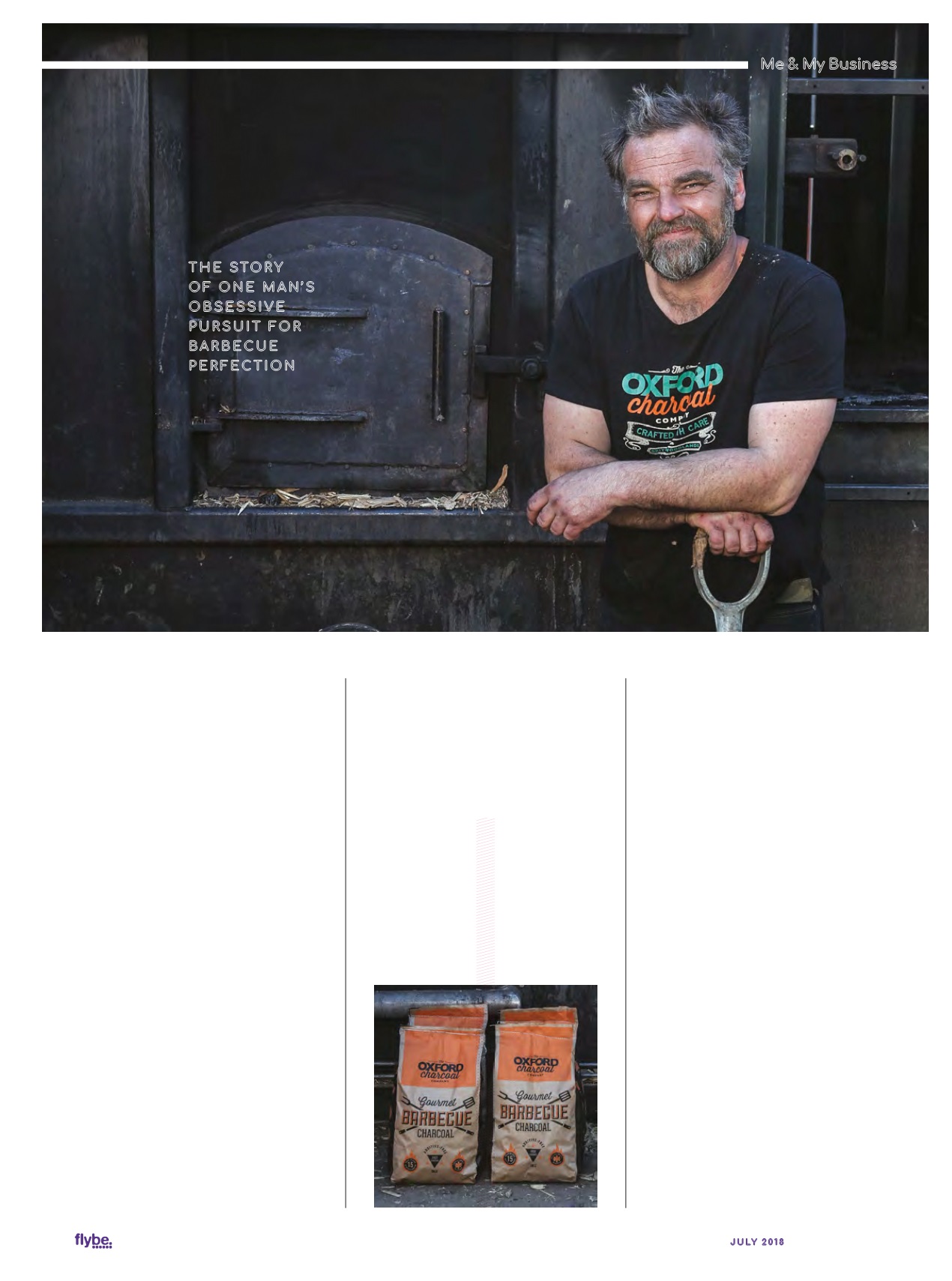
environment, too. Matt’s Oxford Charcoal
Company, founded in 2013, is now the UK’s
largest producer of barbecue charcoal –
although the majority of charcoal on sale in
the UK is still produced, cheaply, abroad, using
wood from tropical rainforests.
Although Matt’s product will fuel hundreds
of fun afternoons and evenings at restaurants
and garden parties this summer, it was
developed in far more stressful circumstances,
via sleepless nights playing with fire and
tinkering with dangerous machinery.
Driven by enthusiasm and a maverick
curiosity, Matt stumbled into the business
by accident and hit upon a way of making a
new kind of gourmet charcoal. He found his
winning formula just as the UK’s foodie boom –
ethically-sourced, quality ingredients – took off.
The first rule of making top-quality charcoal
may come as a surprise. “We never set fire to
our wood,” says Matt. “It’s heated. When the
wood gets to 200 degrees it starts to break
down. We found the optimum temperature
to make charcoal where it retains the flavour
THE STORY
OF ONE MAN ’ S
OBSESS I VE
PURSU I T FOR
BARBECUE
PERFECT ION
M
Burning
love
of the original wood – so when you use our
charcoal, it’s like having an extra ingredient.”
Matt had given up his work as a thatcher
after 20 years, as business was squeezed after the
2008 crash. Living in woodlands near Oxford,
he spent two years trying a range of rural crafts
– furniture-making, spoon-carving – before
finding his niche.
“I had spent a winter making 36,000 roof tiles
from chestnut trees and I had an enormous pile
of offcuts in my garden. I borrowed a traditional
ring kiln to see if I could turn it into charcoal.”
Matt had a Eureka moment when he set light
to the gases coming out of the kiln – and flames
leapt into the sky. “With the traditional kiln, you
were just sending out loads of natural acid out
into the environment. I thought those gases could
be used to fire the whole process. It wasn’t a new
idea. The Ancient Egyptians did something like it
and humans have been discovering and throwing
away that technology ever since.
“Over the centuries we have turned away
from thinking about how to use charcoal as a
fuel: everything that we have used fossil fuels
for could have been achieved with charcoal
– even plastics could be made from burning
wood; in the Second World War we had wood-
gas-powered ambulances. But fossil fuels have
generally been the cheap and easy option.”
“We found the optimum
temperature to make
charcoal where it retains
the flavour of the original
wood – so when you use our
charcoal, it’s like having
an extra ingredient”
Me & My Business