


 66 / 116

66
/
Flight Time
/
JULY 2018
Business Lesson
WITH CYBER CRIME
the
fastest-growing crime, businesses
and individuals need to be aware
of the risks to avoid becoming
the next victim. Here are 12 you
should watch out for.
MALWARE
Malware (viruses, Trojans and
worms) is one of the biggest
threats. Criminals trick users into
installing malware by making
it look like a legitimate update
from a site you trust. Good
firewalls help, although hackers
can outsmart anti-virus programs
which leaves education of end-
users, and good training, the best
form of defence.
RANSOMWARE
When malware encrypts your files
so you cannot access them you
might receive a ransom demand to
pay criminals in Bitcoin. However,
some attacks are designed to
destroy data and cause disruption.
Avoid using administrator or
high-privilege accounts to check
email. Back up files and store them
separately (off network).
PASSWORD PHISHING
Up to 70 per cent of email is
spam, much of which contains
phishing attempts to trick you into
revealing passwords. Sophisticated
spam looks like the real deal – the
only difference will be a subtly-
different URL, taking you to
the cyber-criminal’s site. Check
a URL before clicking, and use
two-factor authentication, instead
of a password and username to
mitigate risk of revealing your
password.
UNPATCHED SOFTWARE
Cyber criminals exploit security
gaps in software. Manufacturers
create and release patches to
bring your software up to date,
so it’s vital to install them quickly
and frequently.
SOCIAL MEDIA THREATS
Social media is a common way
for cyber criminals to introduce
malware, perhaps by sending
you a connection request taking
you to a fake site that steals your
social media credentials. Once
cybercriminals get one password, it
may help crack others.
SOCIAL ENGINEERING
Criminals exploit information
they find about you on social
UN E R
AT T CK
media to create targeted phishing
attacks, guess passwords and
get into accounts, or commit ID
fraud. Social media activity may
reveal more than you think. Check
what you put online, think before
posting anything sensitive, and
check privacy settings.
DENIAL OF SERVICE (DOS)
ATTACKS
These attacks disrupt service to a
network by bombarding it with
high volumes of data or traffic. As
more household appliances become
connected though the Internet of
Things (IoT), criminals can hijack
them to mount attacks. Change the
password from the default setting
and monitor your system for
unexplained spikes in data use.
MALVERTISING
Online adverts may contain
malicious code that infect your
device when you click on them.
Although this can happen to all
sort of ads hosted on sites you
trust, if something sounds too
good to be true, don’t click on it.
MAN IN THE MIDDLE
(MITM)
If criminals access the contents
of your emails through
non-encrypted Wi-Fi, they
can intercept messages and
correspond with contacts
pretending to be you. When a
financial transaction appears
they can send an email from your
account, asking for payment
to another bank account –
theirs! Check websites you connect
to use HTTPS, or consider using a
Virtual Private Network (VPN).
FAKE WI-FI HOTSPOTS
Criminals create Wi-Fi hotspots
in public places, masquerading as
legitimate Wi-Fi. If you log on to
their network they can intercept
communications and even hack
into your laptop camera to snoop
on passwords, files, and anything
you view. Create a secure internet
connection using your own mobile
data – use a local SIM if travelling.
INJECTION ATTACKS
Hackers can insert code into web
app data and take control of your
database leading to data leaks and
breaches. Use Input Validation
to ensure input into apps is from
authorised end-users and enforce
the least-privilege principle to
reduce damage if hackers get in.
MISCONFIGURATION/DATA
HACKS
An error configuring data
online can lead to data breaches,
with company or client data
being revealed. A data leak by a
disgruntled employee can have
the same effect, with confidential
information published online
e.g. through WikiLeaks or by the
media. Use 24/7 monitoring of
systems to detect data leaks and
identify where a breach occurs.
Paul Johnson is Security Operations
Manager of Logicalis, a leading
provider of global IT solutions and
managed services
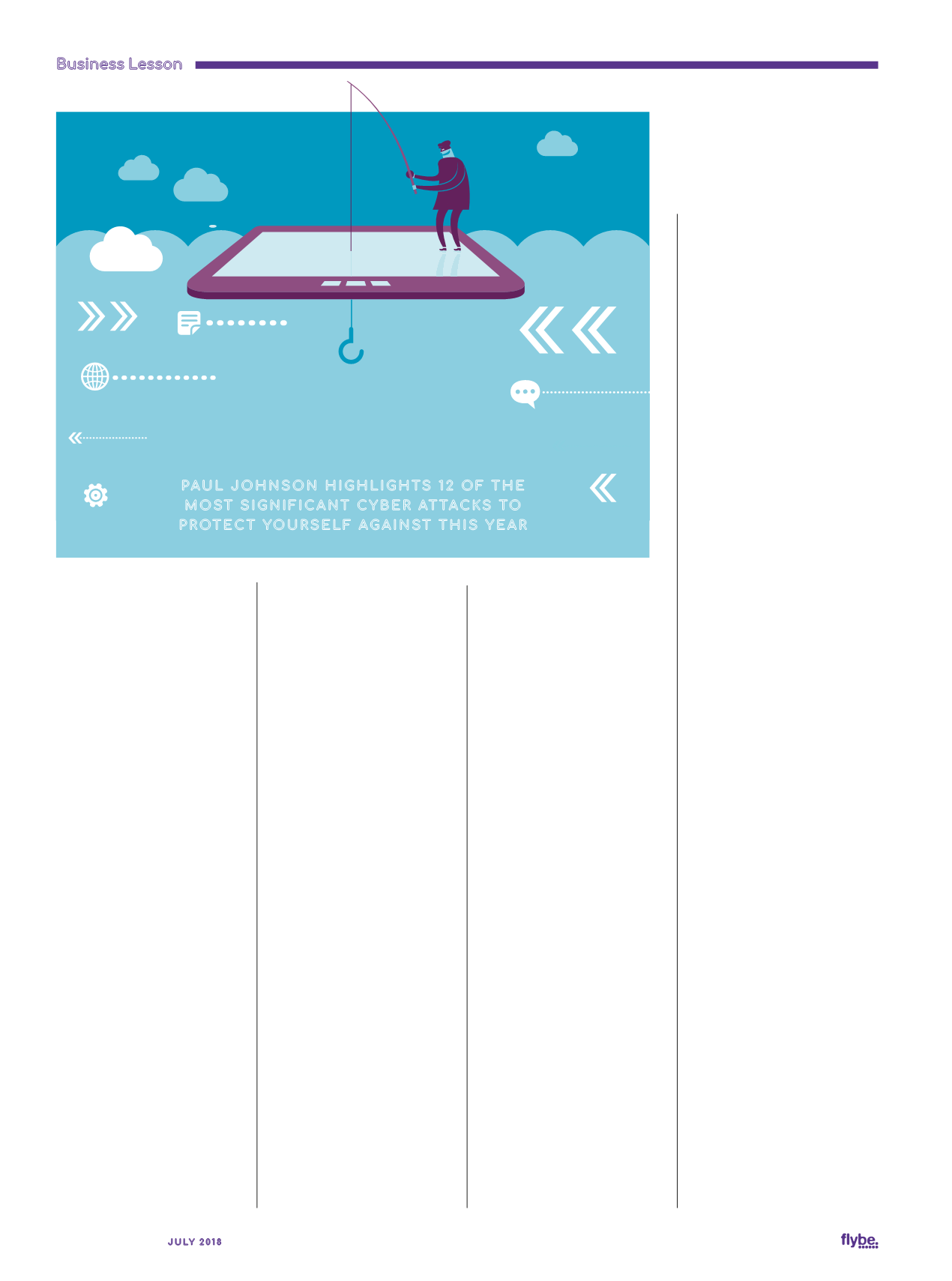
www.uk.logicalis.comPAUL JOHNSON H I GHL I GHTS 1 2 OF THE
MOST S I GN I F I CANT CYBER ATTACKS TO
PROTECT YOURSELF AGA I NST TH I S YEAR
A
D