


 71 / 132

FEBRUARY
71
Gin’s
the thing
Claire Fletcher
rows to work, sharing the oars of
Red
Rose
with her business partners to collect sea lettuce, one
of the ingredients for their success in the Inner Hebrides…
Gin and tonic is now officially the UK’s
favourite tipple. Forty-three million
bottles of gin were consumed last
year in the UK. Exports are soaring.
Tradition has been turned on its head
and a nation of whisky-makers has
become a nation of gin-makers.
There are now 20 registered gin-
makers in Scotland, but only one is an
all-women concern.
The Lussa Drinks Company was
formed in the summer of 2015 by
Alicia MacInnes, Claire Fletcher and
Georgina Kitching. They live within a
few miles of each other in the Lussa
glen at the north end of the Isle of
Jura, where George Orwell wrote
1984
between 1946-48. Orwell (Eric
Blair) described Jura as “extremely
un-get-to-able”.
Alicia, Claire and Georgina distil
the gin themselves, hand-foraging its
ingredients and hand-labelling the
bottles on the remote island thought
to be named after goats or yew trees.
Says Alicia, who has lived on the
remote island for 10 years: “Work
opportunities are limited. We have
one road, a school, a kirk, an 1810
whisky distillery, 200 people and
6,000 deer, plus cattle and many
grey seals.” Jura is also a Special
Protection Area for golden eagles.
“The idea for the gin came after
a chance conversation between
neighbours,” says Claire. “We all
grew plants and liked gin! And when
HMRC relaxed the rules about the
size of stills required for a rectifiers
licence (re-distilling) we bought ‘Jim’
– a 10-litre still – and started up in
my kitchen at Ardlussa House.” Now
they have ‘Hamish’.
Claire remembers the trials – and
errors – of those early days. “We
tried heather, which was revolting,
and had a huge argument about
ground elder! I didn’t want an
invasive weed going in my gin but
Alicia was insistent. It actually gives
a lovely, savoury kick.”
They hired out the island’s village
hall at Craighouse,
offering tastings to
the locals and inviting
constructive comments
on their concoctions.
Says Claire: “Cath and
Andy McCallum, who run
the Jura Hotel and Pub,
were very helpful. So were
established makers like the
Bruichladdich distillery on Islay which
makes The Botanist, Pickering’s in
Edinburgh and Makar Gin in Glasgow.
We did our research and fact-finding,
paid visits and asked questions.”
As for the name: “We looked
at words like “spindrift” but in the
MY BUSINESS TIME
BUSINESS
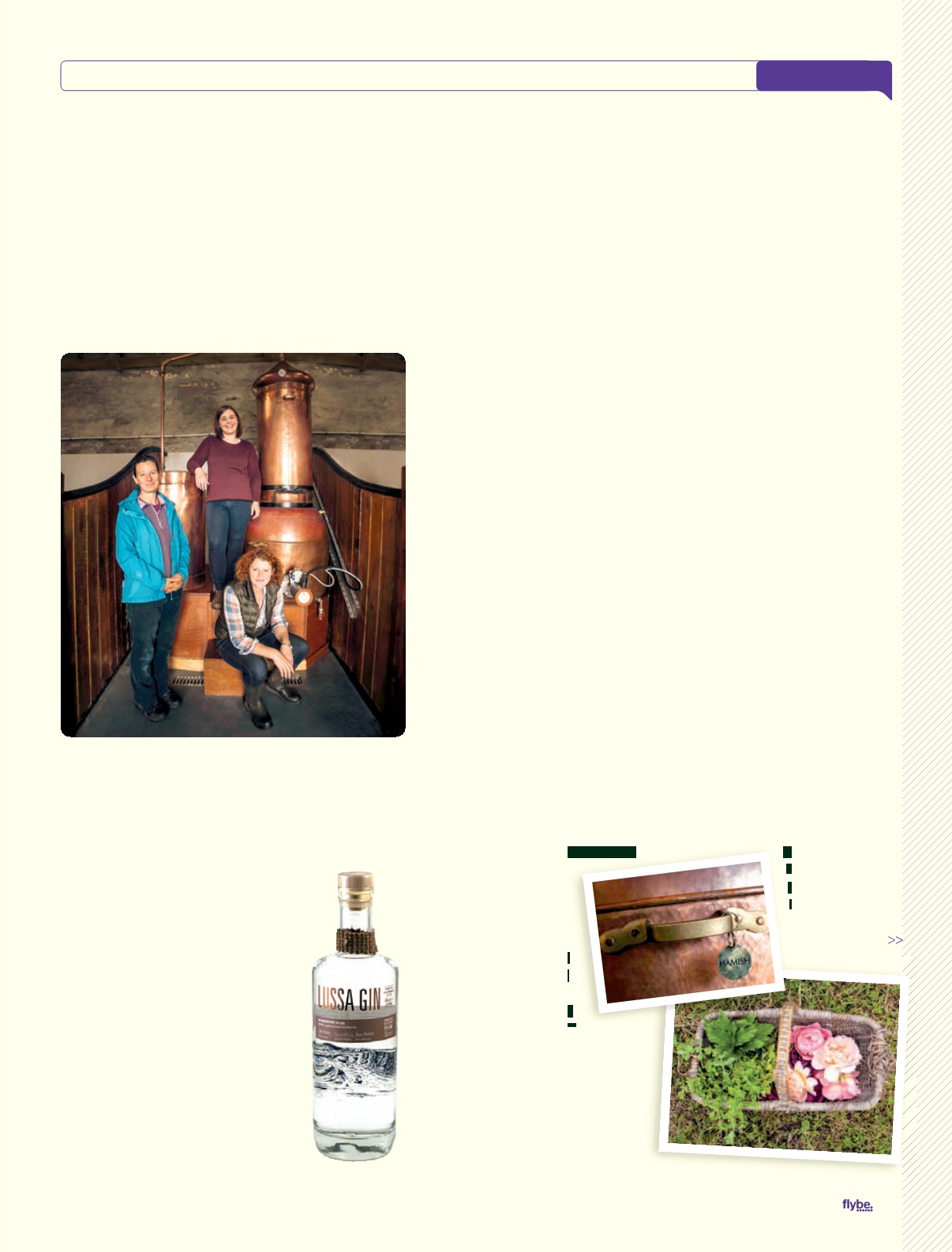
Above:
Claire
Fletcher, Georgina
Kitching and Alicia
MacInnes
Right:
The still’s
‘Hamish’ name tag; a
basket of botanicals
WORDS
KEVIN PILLEY
PHOTOGRAPHS
RACHEL KEENAN
end it came down to location. Our
place. Lussa may mean salmon in Old
Norse, or flowers. The north end of
Jura has place names like Ardluss,
Lussagiven and Inverlussa.”
Georgina, who has two sons and,
like Claire, married into a Jura family,
heads up the operational side of the
business. “I used to be a science
teacher so distilling gin is rather like
doing a giant science experiment.
“Designing the heating system for
Hamish, I used equations I’d been
teaching my physics and chemistry
students for years. Now I’m
confident those equations are, in fact,
completely correct!”
Says Alicia, who is from Perth in
Western Australia: “We all grow
lemon thyme and have two other
polytunnel sources at the Islay House
Community Garden. We pay in gin!
We need over 200kgs this year,
including seaweed and marine algae,
which is widely used in gin.”
Before moving to Scotland, Claire
was executive producer of BBC Radio
Live Music and worked as a producer
on
The Evening Session
for Radio 1.
She came to Jura to film a video on
the rock band KLF and her driver
for the trip is now her husband. They
have four daughters.
The company rowing boat is an
important member of staff.
Red Rose
is owned by Claire’s eldest daughter
and shares the same name as Claire’s
mother-in-law, who is the local postie.
“We all go out and harvest the sea
lettuce, usually in summertime when
it’s free-floating close to the shore.
We immediately
clean it so it’s
free on sand,
then freeze it.”
Explains
Georgina: