


 71 / 116

JULY 2019
/
Flight Time
/
71
Business Lesson
s human beings, we
seek out comfort. It is a
basic primeval instinct
– our natural state is in
the comfort zone. Our cave-dwelling
ancestors had much harder lives than
we do today, and comfort was much
sought out and cherished. Behavioural
scientists have discovered how this
simple principle is hardwired into much
of our decision-making. It drives inertia
and our desire to fit in with others.
This desire to be in the “comfort zone”
impacts organisations as much as it does
individuals. But it raises the question as
to whether you can be too comfortable
and whether this is a bad thing.
The dangers of being
in the comfort zone
In recent years it has become apparent
that for a business being comfortable
can be a dangerous thing. We live in
uncertain and changing times – what the
military, elite athletes and other alpha
individuals like to call “VUCA” (volatile,
uncertain, complex and ambiguous).
Being complacent doesn’t seem smart
or much like a business strategy. Many
executives we speak with are worried
about being disrupted – usually followed
by a reference to Airbnb, Uber or
Amazon (or all three). The fear of
disruption is making even the most
comfort-seeking execs uncomfortable.
In addition to external threats, being
comfortable, sitting in the “Comfort
Zone”, shows a lack of ambition which
is generally not seen as attractive for
investors, employees, or even customers.
Indeed, it is worth noting that the
best strategy to deal with disruption is
often to have great people who are adept
at adapting and reacting to change.
Now, more than ever, businesses are
competing to recruit and retain this
A
talent. Whether it is the millennial
mindset or not, increasingly, we
have seen that those with talent are
not looking for long-term stability
but a challenge to which they can
contribute. Is the company trying to
make a difference in the world, serve
the customer in a different way, beat the
competition, blow up the market – these
are much more engaging challenges than
maintaining scale, single-figure growth
or market share. Talent seems to be
seeking companies with ambition, who
will stretch and develop them, rather
than provide job-for-life stability.
These worries are creating an
interest in this space, if not action!
Is your culture too comfortable?
So how do we know if our business is too
comfortable? Firstly, we exist in an age
of benchmarks and metrics. Like never
before we can track, measure and graph
pretty much anything and everything.
Whether it is our smart watch telling us
to get up off the sofa and put more steps
in, or our LinkedIn account telling us
that activity was down 23 per cent last
week, we have visibility, whether we like
it or not. Although those most securely
anchored in the comfort zone will try to
avoid targets and metrics if they can, it is
often not easy to do so. Although setting
the right metrics is key, the old saying
that ‘what gets measured gets managed’
remains true. The key difference between
high-performance teams and businesses
and those comfort seekers lies not in the
metrics themselves but what happens
when the data comes in. Comfortable
companies will tend to look at poor-
performance metrics (such as growth
rates, market share, service metrics) and
spend time on providing explanations.
Those who are looking to grow and
stretch will focus their energies on using
the information to learn and improve.
In our experience, these high
performers have a very different mindset
from those in the comfort zone. As we
will see, our research shows that high
performers tend to push themselves
by operating in a “Stretch Zone” – they
achieve more by looking to do more,
they want to learn, progress and grow.
Being in the comfort zone is a much
more passive mentality – either implicitly
or explicitly, the focus is keeping the
status quo. It is inherently internal and
defensive… and therefore, ironically, it is
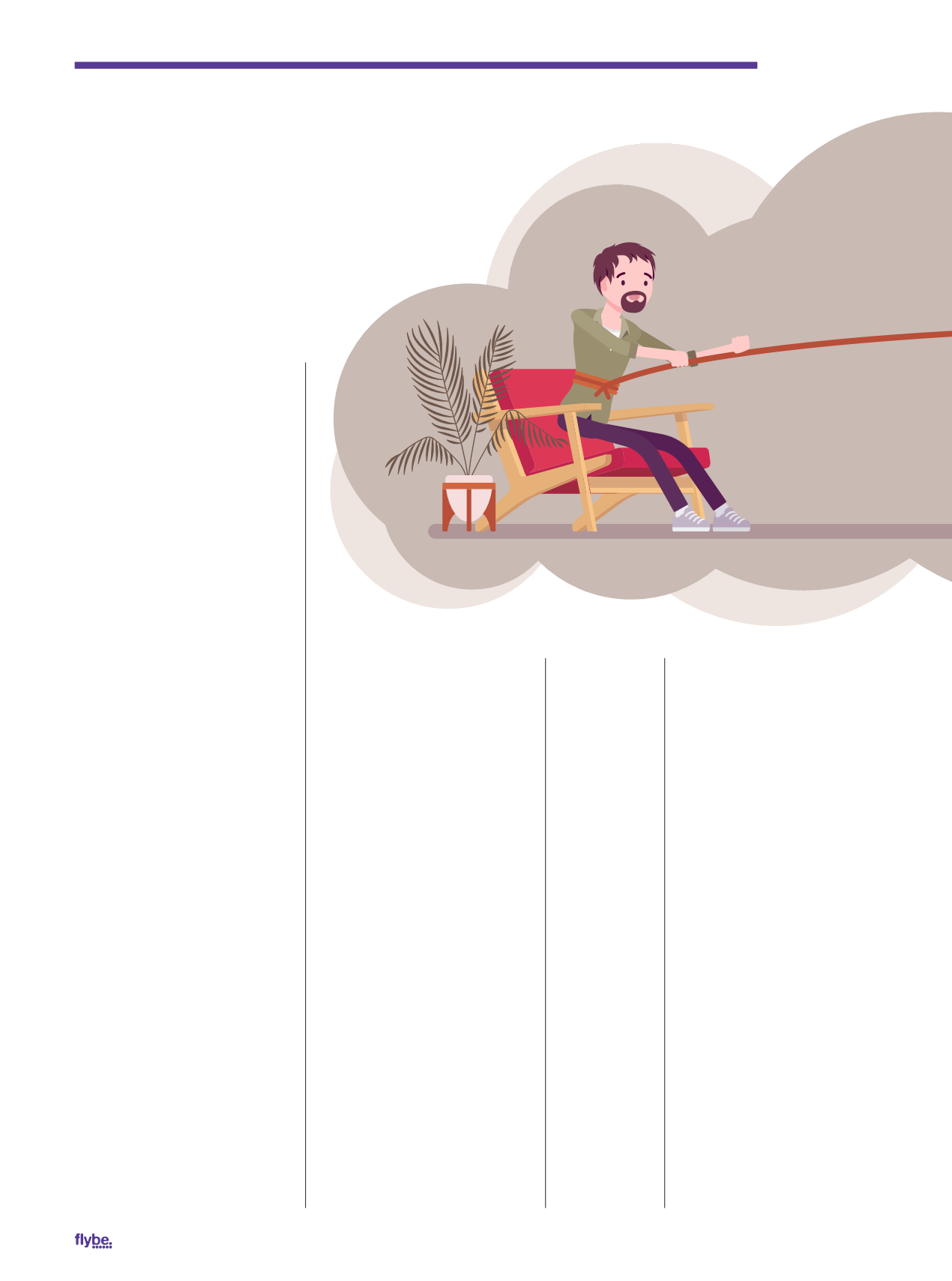
ARE YOU SITTING
COMFORTABLY?
A BUSINESS CAN BE TOO COMFORTABLE ,
AS NICK PYE EXPLA INS