

 86 / 116

Flybe’s World / Our Fleet
86
/
Flight Time
/
SEPTEMBER 2018
Ourfleet
FACTS ABOUT THE FLYBE AIRCRAFT – AND YOUR QUESTIONS ANSWERED
WHAT IS A FRANCHISE?
Not on one of the aircraft above? You’ll be travelling with one of our franchise partners. A franchise is where another
operator is allowed to fly their planes under the Flybe brand, with our agreement. Your journey should look and feel
like any other Flybe flight. Although technically a different company is operating it, these franchise airlines closely
follow our customer service and brand guidelines, so you enjoy a very similar experience.
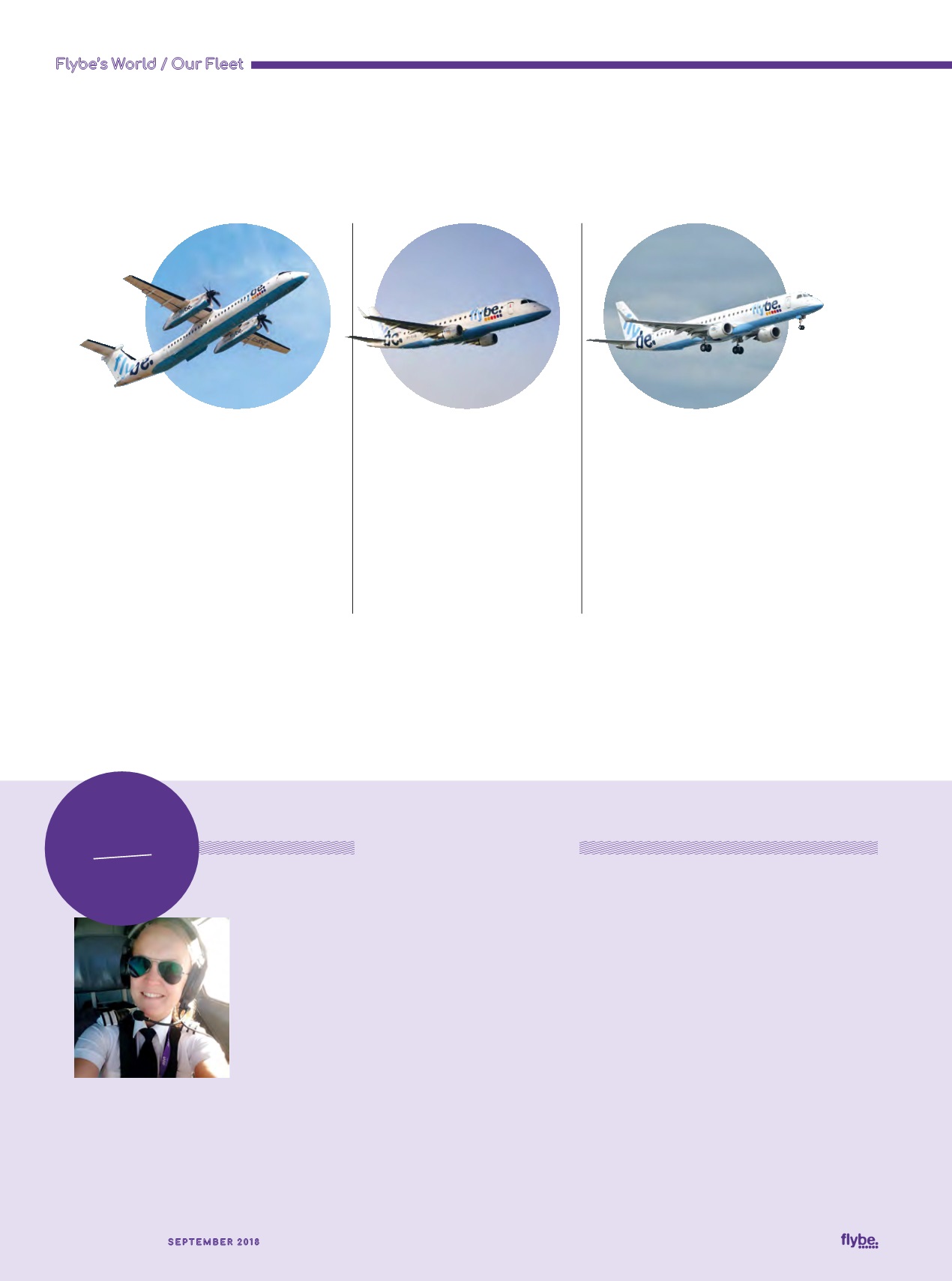
BOMBARDIER DASHQ400
Pilots/Cabin Crew:
2 Pilots, 2 Cabin Crew
Seats:
78
Engine Type:
Pratt & Whitney Canada PW100
Weight:
29 tonnes
Max Altitude:
25,000 ft
Max Speed:
410 mph
Range:
1,300 miles
EMBRAER E175
Pilots/Cabin Crew:
2 Pilots, 2 Cabin Crew
Seats:
88
Engine Type:
General Electric CF34-8E
Weight:
38 tonnes
Max Altitude:
41,000 ft
Max Speed:
550 mph
Range:
2,000 miles
EMBRAER E195
Pilots/Cabin Crew:
2 Pilots, 3 Cabin Crew
Seats:
118
Engine Type:
General Electric CF34-10E
Weight:
51 tonnes
Max Altitude:
41,000 ft
Max Speed:
550 mph
Range:
1,900 miles
Why do we fly around in
circles before landing?
At some larger, busy airports,
Air Traffic Control place us
in a “hold” – almost like a
racetrack in the sky – where
we join a queue to make an
approach to the airport. Quite
often there can be four or five
aircraft in these holds and
an airport like Heathrow has
four separate holds almost
always in use. Once released
by Air Traffic Control, we start
to make an approach for the
airport.
GLASGOW- BASED
FIRST OFFICER
AILSA COLLIE
ANSWERS YOUR
QUESTIONS
Why do pilots or cabin crew
travel as passengers?
Every year, all pilots complete
at least four days of simulator
training and assessments at
Flybe’s Training Academy in
Exeter. Our cabin crew also
have to complete training
every year at Exeter, which
means that they travel across
the network to attend their
training. Also, although a crew
member might be based
out of one airport, we are
sometimes positioned to fly
from other airports around the
network depending on crew
availability.
What’s that trail of mist
coming from the wingtip?
They’re called contrails
and are just water! A wing
produces lift by creating a
pressure difference between
its upper and lower surface.
As part of this process and
under the right conditions of
temperature, pressure and
humidity, moisture or water
vapour becomes visible from
the tip of the wing.
Ask thepilot
HAVE A
QUESTION FOR
ONE OF OUR
PILOTS?
Email:
as
kourpilots@ flybe.com