


 55 / 116

SEPTEMBER 2018
/
Flight Time
/
55
Wanderlust
He had led us in warm
evening sun across Kenfig
National Nature Reserve to
the secret location at which
he had hoped we might find
the orchid.
The reserve comprises
two miles of coastline and
hinterland a few miles
north-west of Porthcawl. It
is what remains of a huge
former dune system that
once extended from the
sand mountains of Merthyr
Mawr all the way to the
Gower peninsula.
Rolling duneland
surrounds the natural lake
of Kenfig Pool, beyond
which, in the mid-distance,
rise the rather ghostly
towers and chimneys of
Bridgend steelworks.
It’s home not just to the
fen orchid, but to several
others, such as the southern
marsh orchid, while yellow
flag iris sprouts from the
numerous ponds and
marshes to paint – with the
many species of butterfly –
a picture of bright summer
colours.
On a hot summer’s
evening, it was hard to think
of a nicer place to track
down an orchid!
www.kenfig.org.ukNATURE I N
THE WI LD
“If you’re a dedicated
orchid-spotter,” said Dave
Carrington, “then this is just
about as good as it gets!”
“This” was the
exceptionally rare fen orchid
(dune variety) and – led by
Dave – we’d tracked it down
in a little under an hour.
True, it wasn’t one of those
wildly-exuberant, brightly-
coloured super-blooms you
might find in the depths of
Amazonia. But it was almost
certainly rarer – and we’d
caught it unawares, with no
escape route.
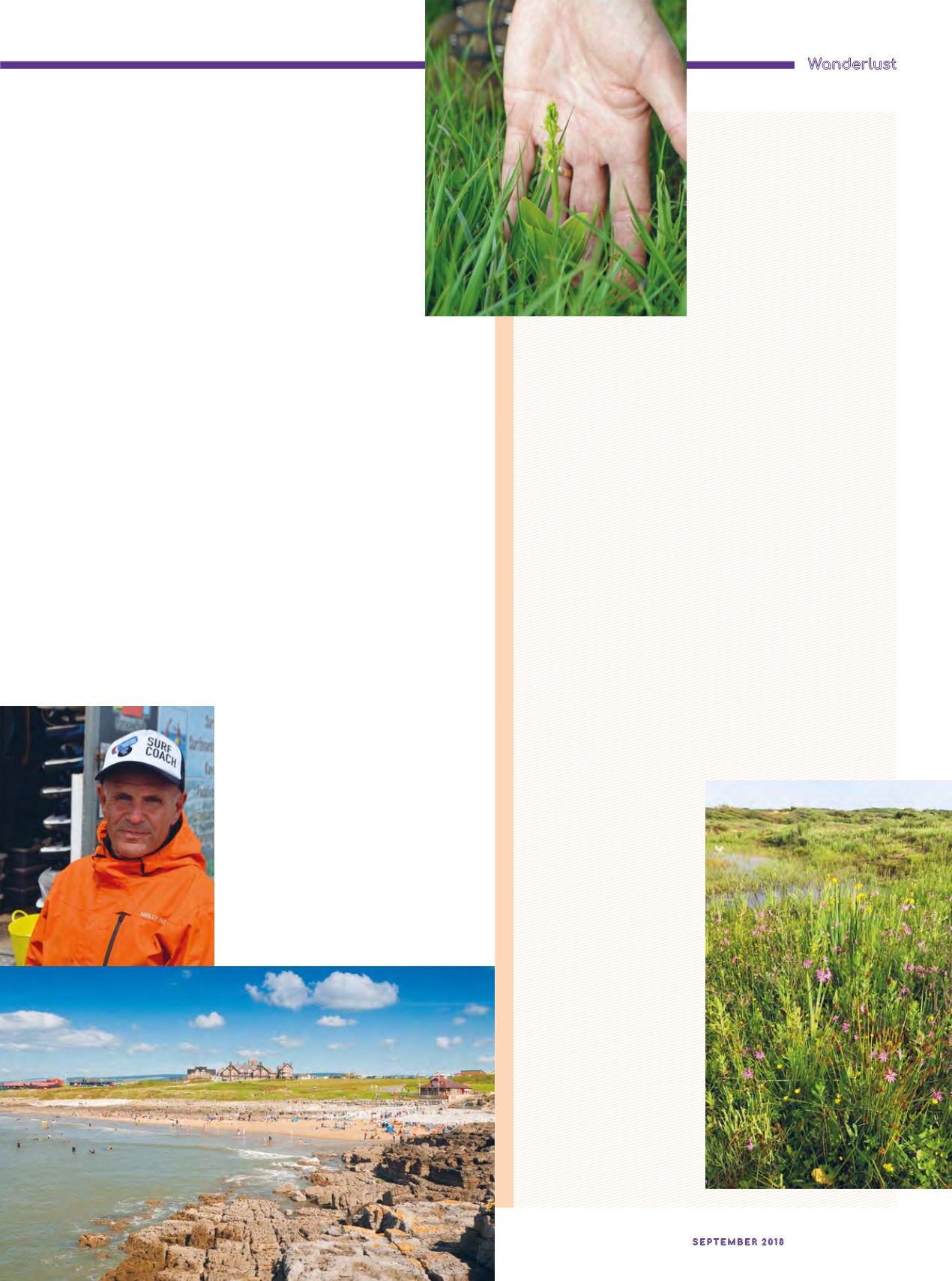
The fen orchid (dune
variety) may look like
nothing more than a small
stick of asparagus with pale
yellow flowers, but there
is, quite literally, only one
place in the whole of the
UK at which you may just
be lucky enough to see it,
during its all too brief early
summer flowering season.
The feisty little critically
endangered flower has
just two cousins in the UK,
in East Anglia and north
Devon, and much of its
lifestyle remains shrouded
in mystery. Although it’s
known that a specific type
of fungus is important to its
germination, details of its
sex life are the subject of
ongoing research that has
yet to throw up an answer.
“Perhaps it’s like greenfly
and can reproduce
asexually,” I mused, tongue
in cheek.
“That’s one of the
possibilities under
consideration,” responded
Dave, with a straight face.
based around the hobby he’d enjoyed for
years. “I was a financial adviser until the
financial crash, and then my business dried
up overnight,” he recalls. “I’ve surfed for
about 40 years and I even had a surf shop
then, but that went down the pan, too.”
Now he’s boss at the award-winning
Porthcawl Surf, with an aspiration to move
into a planned new surf shop and café at
Rest Bay, on the northern edge of town. It’s
a great little bay, with lifeguard on hand and
a reef that delivers good surf in even modest
swell, and exceptionally good surf, says
Hugh, between October and February.
“In terms of location, we are the nearest
surf beach to London and most of our
business comes from Bristol and Reading and
places on the M4 corridor.
“This beach is open to the south-west, so
we get the big surf, but the downside is that
it’s open to the wind, too. But we also have
Coney Beach, which is somewhere to surf,
no matter what the conditions.”
Indeed, surfing, it seems, is deeply etched
into the local culture here, with 1,000 local
children, aged seven to 16, enrolled in five
local lifeguard clubs and helping to endorse
Hugh’s assertion that “safety is everything”.
After our own safety brief, we get our
first taste of the surf. Even gliding shoreward
Opposite, clockwise from far
left: Tackling the steep sand
dunes of Merthyr Mawr; a brief
rest for writer Stan Abbott;
looking down on Merthyr Mawr;
fat biking in action
Left: Surfer Hugh Murray
Below: Rest Bay, perfect
for surfing