



 67 / 132

SEPTEMBER
67
WORK TIME
BUSINESS
This takes considerable self-discipline, but
learning how to habitually stand back and
deliberately imagine that events in your
life will have a positive outcome will help
make you more successful and happier.
Visualising success means taking the time
to reflect on and recognise your automatic,
probably pessimistic, thoughts and, instead,
create a detailed picture of the sights,
sounds and feelings you actually want to
have. This means you need to visualise
clearly and in detail the outcomes you want.
Nail that interview
For example, your interview is next week.
Think through the interview moment by
moment and visualise yourself seeing,
hearing and feeling it as a positive
experience. Rehearse the interview going
like this over and over again. Doing so
will programme your brain to expect a
good experience. The more extreme the
positive feelings in this mental rehearsal,
the more your emotional brain will respond.
You need to make your mental rehearsals
visualisations of outstanding success, not
just mediocre survivals. This may go against
your natural modesty – but it works.
As you are preparing your materials
for the interview, keep repeating this
visualisation as many times as you can
so that it starts to feel natural. Sports
psychologists use this type of positive
visualisation so sportspeople can rehearse
getting the perfect bullseye, snooker
pot or penalty kick. If you visualise an
outstanding performance over and over
again, it seeps into your unconscious mind,
helping overcome tension and nerves.
Overcome the doubts
Beware! It is hard not to let doubts creep
in and undermine you. Your inner critic
might say mockingly, ‘Oh, this is stupid.
It’s all bound to go wrong.’ Thoughts
like this will be linked to negative visual
images and feelings that will threaten
all your hard work. Look at them
dispassionately and dismiss them for what
they are – barriers to growth. Whatever
your forthcoming challenge, visualise it
going well. Make it big and bold and an
outstanding success in your imagination.
Repeat it. And repeat it again.
Once you have felt this work, try to
trigger positive mental rehearsals for
other aspects of your life, such as when
you are facing tough times at work or
in family situations. A helpful trick is to
use the ‘nudge’ strategy to help you do
this. The nudge strategy was outlined by
Thaler and Sunstein in their book of the
same title, and shows how the choices we
make are swayed by minor, apparently-
trivial influences. As they said: ‘Small and
apparently-insignificant details can have
major impacts on people’s behaviour’.
We see this in the placement of
supermarket offers on sweet treats, health
warnings on cigarette packets, hand
sterilisers by the doors of hospital wards.
Simple reminders to do the right thing are
around us all the time. They nudge people
into making certain choices by prompting
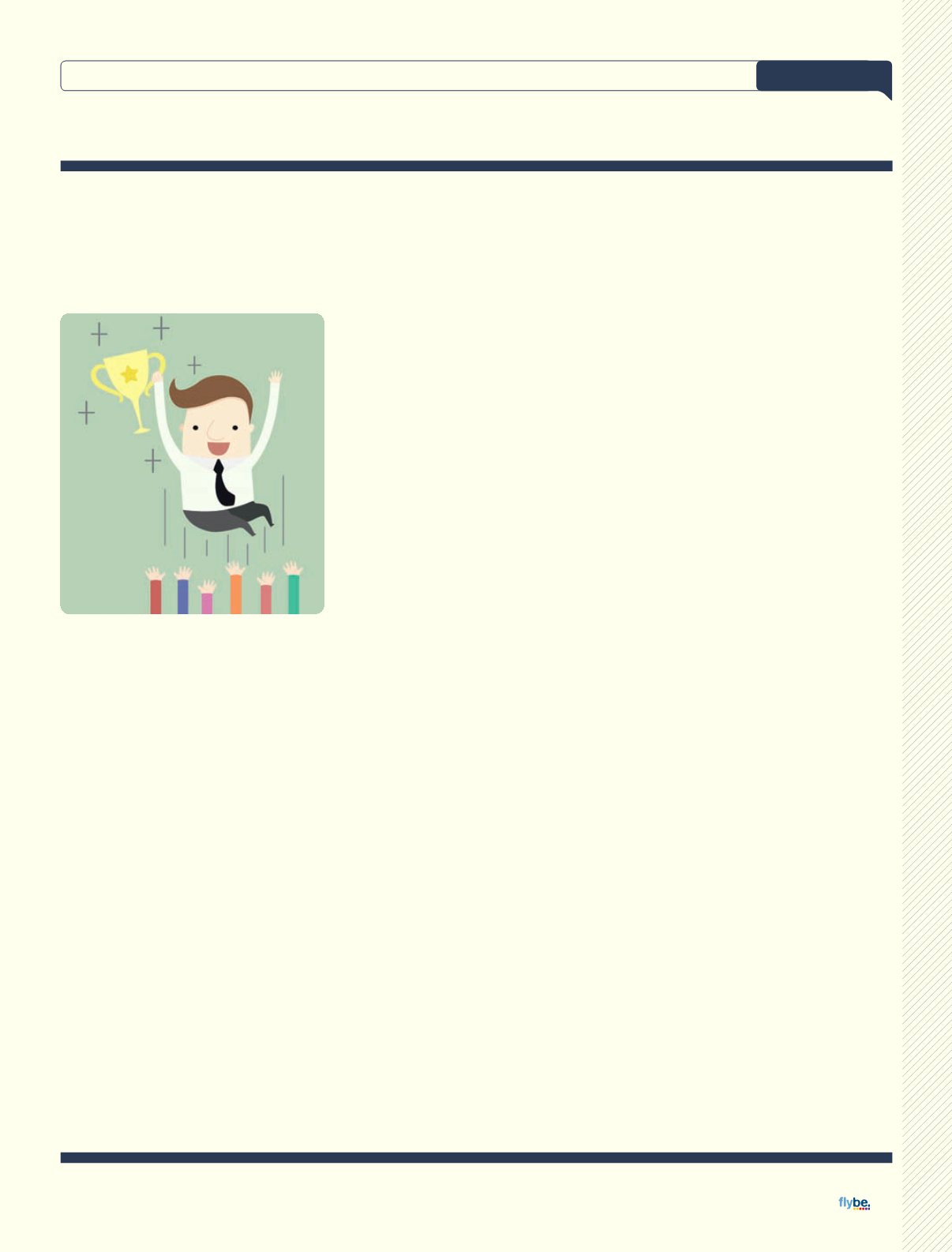
Whatever your forthcoming challenge, visualise it going well. Make it big and bold and an
outstanding success in your imagination. Repeat it. And repeat it again…
Get the outcomes you want by using simple techniques and
nudge strategies for an improved mindset
Visualising Success
their brain with temptation: sometimes
for commercial reasons, sometimes for the
common good. As we move through life in
automatic mode, a small nudge can change
our behaviour. Supermarkets know this
and nudge us to choose more products by
putting them in our eye line and reminding
our emotional brain that we like them.
Even if we have a shopping list we can be
unconsciously persuaded to add random,
impulse purchases of products that we
didn’t know we needed.
Use the nudge technique
We can use the nudge technique to snap
us out of automatic pilot and help remind
us to do our visualisations and repeated
rehearsals. Nudge strategies you can use
to do this include:
•Making a list and working your way
through it
•Creating a mantra such as ‘Think
you can’ and putting it above your
bathroom mirror
•Choosing a tune such as ‘Happy’ to
hum when negative thoughts creep in
•Using a physical movement such as
deep breathing or shoulder rolls to
create states of relaxation
•Creating a definite physical anchor (an
anchor is a shortcut to a state of mind)
such as you imagine in technicolour
the great outcome you want from a
situation. This physical act can remind
your brain how to feel positive just
when you need it
•Using gentle phone alarms to remind
you to check your thinking in stressful
situations
•Writing a symbol or message on your
hand, such as a smiley face, to act as a
trigger for good thinking
This is an extract from
GROW: Change your
mindset, change your life – a practical guide
to thinking on purpose
, by Jackie Beere,
published by Crown House Publishing. The
book is priced at £9.99 and is available from
Amazon and bookshops. Jackie is author
of several bestselling books on teaching,
coaching and learning as well as being a
qualified Master Practitioner in NLP.
www.jackiebeere.com