



 44 / 132

44
SEPTEMBER
CONCIERGE
TRAVEL TIME
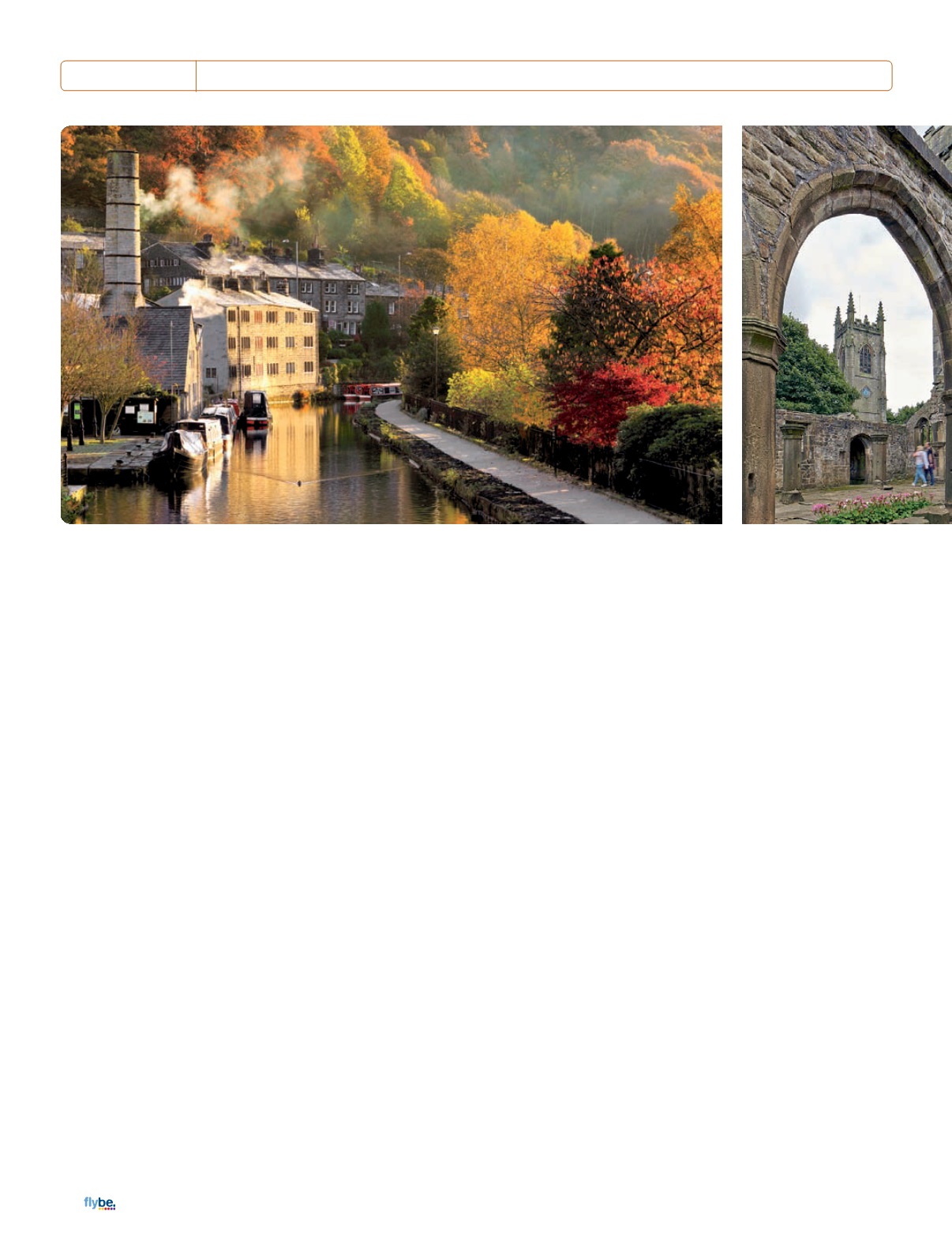
Above, left to right:
Hebden
Bridge canal in autumn;
Heptonstall Church ruins
Opposite, clockwise from left:
Canal towpath in Halifax;
sunrise in Hebden Bridge;
Bridestones near Todmorden
although a number of routes head up to the Pike,
some of the footpaths leading up through the hamlets
of Lumbutts and Mankinholes are a delight.
Further down the valley is Hebden Bridge, the
most frequently visited of the Calder Valley towns.
Resembling a living museum of the industrial
revolution, Hebden Bridge, like many towns around
here, had a booming textile industry in the 19th
century. Many of the mill chimneys are still in place,
as is the Rochdale Canal, which is used for leisure
cruising these days. Picturesque old weavers cottages
sit beside the canal, and on the edge of town,
terraced houses cling for dear life to the steep sides
of the valley.
Head for the town centre, which has plenty of
quirky shops, as well as art galleries and cafés to keep
visitors amused. Unfortunately, Hebden Bridge and
neighbouring villages have long had problems with
flooding. The valley is narrow and the River Calder in
spate has nowhere to go other than the towns. The
Boxing Day floods of 2015 devastated Hebden and
nearby Mytholmroyd, but the towns have bounced
back and are open for business. As a result your visit
is invaluable to the local economy.
Being in the valley’s bottom at Hebden Bridge
makes you wonder what views could be had from
the surrounding hills. A steep road heads north from
the centre of Hebden Bridge, climbing 500ft in a
short distance. Or better still, from the centre of
Hebden see what the packhorses had to deal with
and hoof it up The Buttress, a setted (cobbled) track
which will get the heart thumping. It’s so steep
there’s a handrail! The ‘Up The Buttress’ challenge is
held each September, when cyclists try and make it
up the hill against the clock. At the top is the secret
world of Heptonstall, Calderdale’s best go at a
chocolate-box village, albeit with a gritty edge.
Heptonstall has yet more steep roads lined with
little cottages constructed from the dark local stone,
millstone grit. The village has a church, an unusual
octagonal chapel and the ruins of the older church
of St Thomas a Becket, which dates back to the
13th century and can be freely explored. And there’s
not a tourist shop in sight. Footpaths around the edge
of Heptonstall look into the abyss below, and if visiting
on an autumn or winter morning, you may find
yourself peering down on a blanket of mist or fog,
perhaps with mill chimneys poking through, like a
scene of smog from 200 years ago.
Many visitors to Heptonstall arrive to pay tribute to
American poet Sylvia Plath, who is buried here. She
was married to Poet Laureate Ted Hughes, who was
born in Mytholmroyd and was greatly inspired by the
local landscape.
Also on this north side of Hebden Bridge is the
National Trust’s Hardcastle Crags. This is an area of
woodland and river walks which should not be
missed. Those visiting the Crags in late October
through early November are in for a treat as the
autumn colours are very special indeed – make sure
you take the camera.
Continuing east along the Calder Valley you arrive
at the villages of Mytholmroyd and Luddenden Foot.
There’s little to hold the attention of visitors here,
with the exception of Walkley’s Clogs, the UK’s
largest clog manufacturer and certainly worth a visit